

How To Draw Graphic Novel Style
Tutorial: Comic Book Mode Graphic Blueprint
Hey designers, want to run across the Go Media team? Attend our spread-out soul-fulfilling three-24-hour interval design retreat, WMC: Off-The-Grid, this October v – seventh. To learn more, head to wmcfest.com.
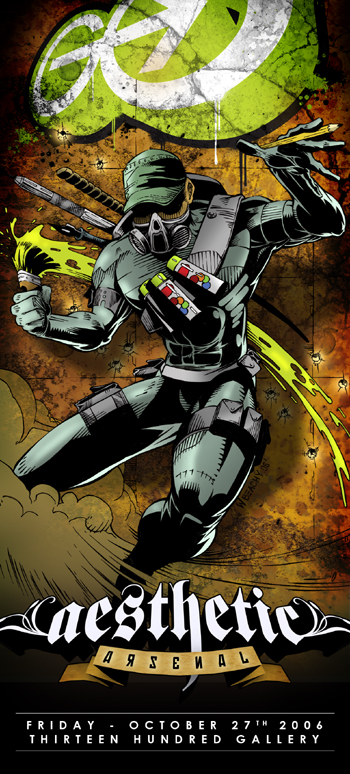
We accept often been asked the process by which nosotros create our illustrated flyers and posters. I will try to give you a clear tutorial on how our Ohio graphic designers create our illustrations and turn them into flyers or posters. Our stop product will be this flyer which was created for our contempo Go Media Inc. fine art evidence:
Before I become into an insane amount of details I want to give you a quick snap-shot of the procedure:
- Describe with Pencil on Paper.
- Ink your penciled artwork.
- Scan your artwork at 300 dpi.
- Create a second copy of the artwork at 150 dpi.
- Create a color layer just nether the artwork (set your artwork layer to multiply)
- Color your artwork.
- Delete the artwork layer, and return the color layer to 300dpi
- Open the original 300dpi artwork and paste it above the color layer.
- Flatten the epitome and relieve information technology.
- Import the image into your pattern software
- Add text and graphics
- Consign the final blueprint.
Step one. Draw with Pencil on Paper. The very first footstep is the pencil drawing. I could write a novel virtually how to draw, but this tutorial will focus on the process of the steps it takes to get from pencil drawing to the finished, designed, commercial slice of artwork.
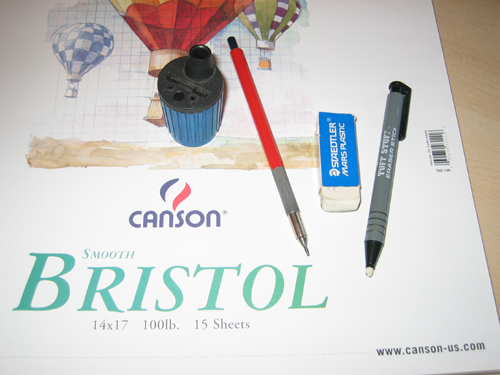
Tools you'll need:
Paper: I apply a plate end Bristol. This blazon of paper is heavy enough to handle a lot of erasing. It is as well thick enough to not wrinkle when y'all are in the inking phase of this process.
Pencil: I actually employ a mechanical pencil like the KOH-I-NOOR Technigraph 5611 Atomic number 82 Holder. This type of mechanical pencil holds a very thick piece of graphite that you lot sharpen and use similar to a existent pencil, except information technology'southward amend.
Eraser: I use the Staedtler Mars Plastic eraser. And a Sanford Tuff Stuff eraser stick.
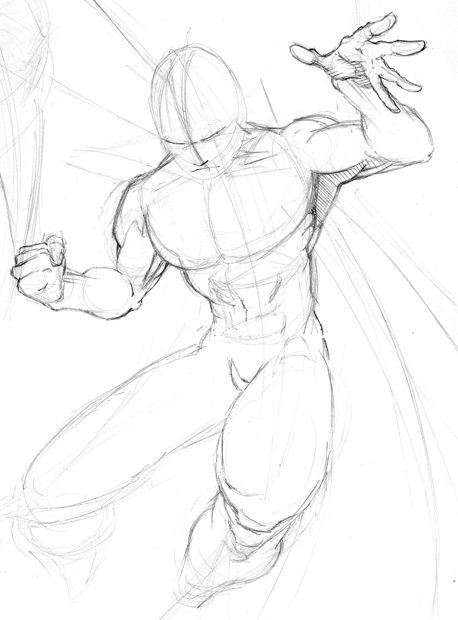
I think that information technology is important to stay fairly loose when you are in the pencil cartoon stage. Start with basic shapes, go along your lines adequately low-cal and when you kickoff to see the shape you're going subsequently y'all can focus in and "tighten" upwards your cartoon.
Here is a sample of a adequately loose pencil drawing:
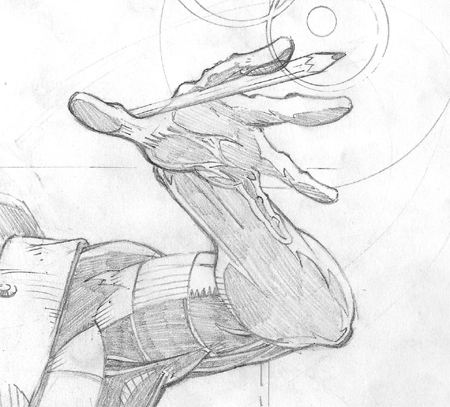
Hither is a close-upwardly sample of a fairly tight pencil drawing:
A give-and-take of encouragement nearly drawing: I think well-nigh illustrators are far too hard on themselves. They expect to sit downward with one piece of paper and draw exactly what they accept in their heed the very start time around. In my opinion this is nearly impossible. Drawing is a process that takes a long time. I like to brand an analogy betwixt a proficient batter in baseball and a good illustrator. A great batting boilerplate for the major leagues is ".300." This batting average means that they get 3 hits out of x, or go a hitting 30 percent of the fourth dimension. I retrieve that this is a reasonable expectation for an artist to accept as well. If I tin get three decent drawings out of ten attempts – I feel adequately good almost myself.
So, relax while you're in your pencil drawing phase of this process. Go yourself a big stack of paper and get loose, depict lots and don't exist concerned about "bad" sketches – just toss them aside and offset over.
Here is our finished tight pencil drawing:
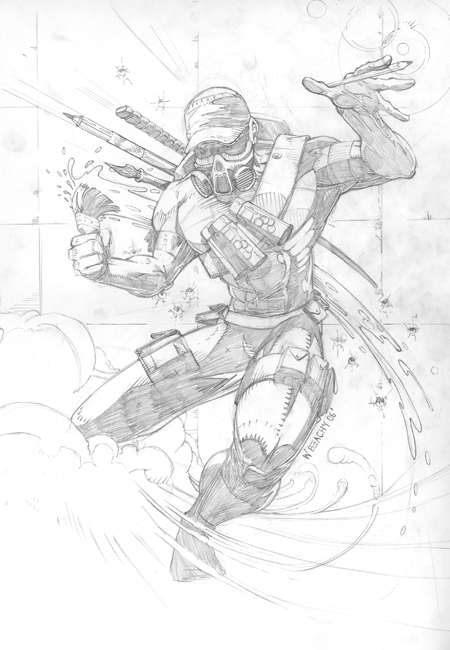
Step 2. Ink your penciled artwork. The 2d step is inking the cartoon.
Tools yous'll demand:
Paint Brush or Crow Quill Pen: I really use a very small paintbrush (like a #one, #ii or #3).
India Ink: Some Republic of india inks are thicker than others. I like a nice thick Bharat Ink. I have had success with Higgins Waterproof Black India Ink.
Marker: any blackness waterproof marker should practise.
Here is a sample of the brush I use: It is a regular #0 Windsor & Newton camel hair paint brush. I take also had cracking success with the new synthetic nylon or polyester fiber pigment brushes. Y'all volition too notice I roll masking tape around the castor near the tip. I do this but to get a better grip of the brush. I feel like I have improve control over the tip with this extra handle.
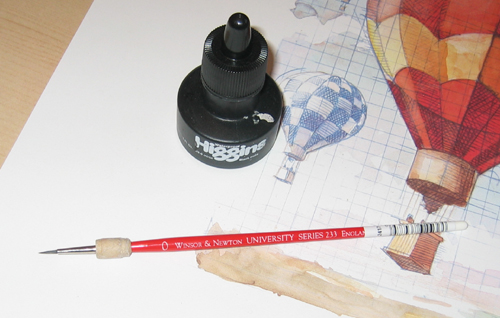
The large areas of black I fill in with a marker.
While you can ink with mechanical pens and markers I think it is important to use either crow-quill ink pens or paint brushes considering it gives you the ability to vary the thickness of your lines. In some spots you'll want to button down and create thick lines and then in others y'all'll want to lift up to make very thin lines. Experiment with this to encounter what works.
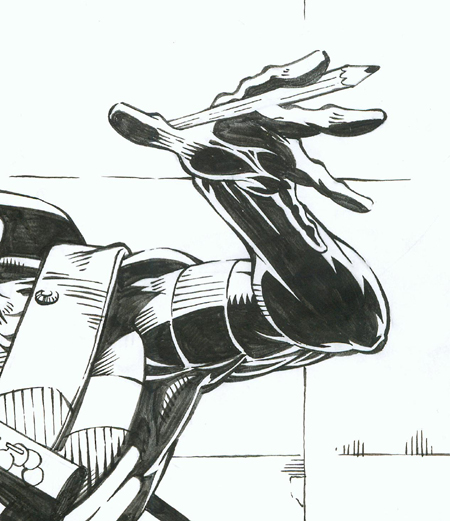
A couple tips nearly this: Kickoff, you can create more than depth in your drawing by doing this. Objects in your drawing that are closer to you should be drawn with thicker lines. Objects that are in the background should be fatigued with thinner lines. This will create a sense of depth in your drawing.
Also – if there are vivid spots – for case a light source is behind an object, and the light source is but over your objects border – the outline of this object might actually thin to the point where information technology stops, there is a gap, then the line starts upward again.
After I dip my castor in the India ink sometimes there is too much ink on it, so I will tap it on the ink well, or depict a few lines on a bit of paper before I go to my drawing.
It is also of import that you are using the correct newspaper. Bharat ink will spread like crazy on some papers. Get a few varieties of Bristol paper and experiment. I find that a thick polish or plate finish Bristol is the best.
If you have large areas that yous need to "fill" I suggest using a blackness waterproof marker.
Once you're done inking your drawing I unremarkably wait for at least an hour before I get back and erase my pencil lines. I will utilize the same plastic eraser and just run information technology over the entire drawing. If your ink is not dry it will smear, and so give information technology plenty of time. One time the ink is dry you should be able to safely erase the entire paper and the pencil will disappear and the ink will stay.
Pace 3. Scan your artwork at 300 dpi. Once your blackness and white artwork is complete – you'll have to get information technology into your computer for coloring.
Tools You'll demand:
Computer: From here on out you'll be working on a computer. I recommend a powerful design station, but apparently you lot'll have to work with any is available. If your fine art is pocket-sized a elementary computer should be fine. But if you lot are working at a very large calibration – you'll demand processing ability to handle the size of the file.
Scanner: I really wish I had a large format scanner. That would like my life much easier. Just I only have an viii.five×14 inch scanner. This typically means that I need to scan my artwork in pieces and sew together them together. This tin can be a chip of a pain in the butt.
Adobe Photoshop or Corel Painter: I personally use Adobe Photoshop but I think Painter is probably better. I apply Photoshop because that is what I learned on and am almost familiar with.
Stitch your artwork together. Since I ofttimes have to scan my artwork in pieces, since it's as well large for my scanner, I recommend that you employ these tips:
- Align 1 border of your paper with the edge of the scanning surface. Once y'all scan one office, slide the fine art keeping 1 edge of your art aligned with the edge. This will keep your art from rotating, so that stitching information technology together will be easier.
- Scan your artwork at 300 dpi. This is high resolution or "print" resolution. Typically I shrink the artwork downwards later only it's better to start with too much resolution than also little.
- Stitch your artwork together by bringing all of your pieces together onto one large canvas and lining them up. If yous ready each paradigm layer to "multiply" it will brand lining them up easier.
Once yous take your black and white image scanned into the figurer and stitched into 1 piece of art you'll need to resize the image to the final size yous'll want your artwork. On this art we're going to make a 4"x9" flyer. So, nosotros will shrink the artwork to iv" beyond and then add extra canvas so that our final art size is 4"x9".
*If you're going to exist adding graphics and text higher up or below your artwork – you may want to take a moment and sketch out how y'all're going to layout your graphics now. If, for instance, yous want to add together a text title above your illustration – how much space are you lot going to need? This mode, you'll have plenty of background art for use one time you get onto the designing phase.
Hither is the concluding scanned art:
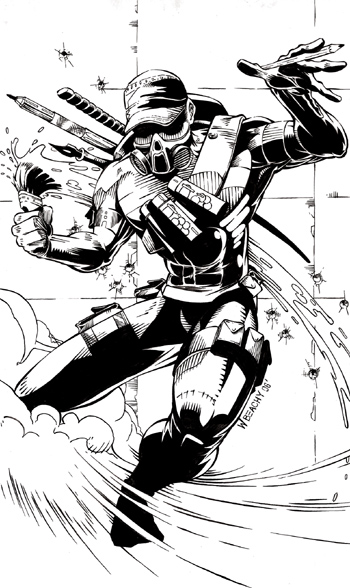
Footstep 4. Create a second copy of the artwork at 150 dpi. Save a re-create of your black and white artwork at 300 dpi. Set this aside – you lot'll need it later. Then create a second re-create of this artwork at 150 dpi. This is the file that we're going to utilize for coloring. You will be coloring at this lower resolution because it's easier on your computer.
Footstep v. Create a "color" layer only under the artwork. Your Photoshop layers should be ready up like this:
Top Layer: Your Black and White Artwork. (set up this layer to "multiply" so you can meet the color backside your line art.)
Middle Layer: Blank Layer to be used for coloring (As well set up to multiply)
Background Layer: White.
Step 6. Colour your artwork. The process of coloring is a very complex subject matter. I will not be able to go into all the details of coloring but here are a few tips:
Fill the main shapes with a color that has a medium value (not to vivid, non too dark – somewhere in the middle.) Then become back and add the shadows and vivid spots off of this medium value colour.
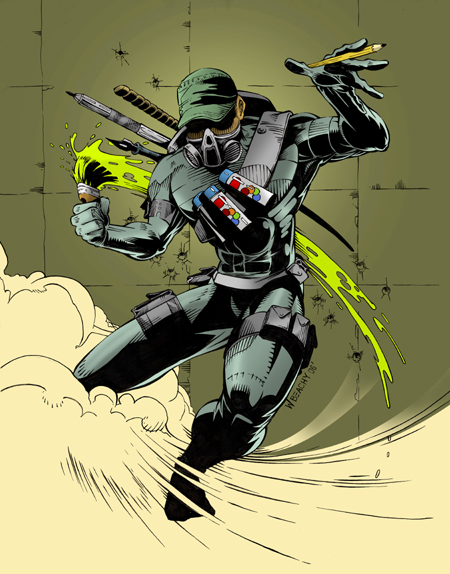
Switch to your artwork layer, employ your Magic Wand to select an surface area on your artwork that you want to color, and then switch back to your color layer to paint your color. In this manner you tin colour carefree without fear of going "exterior the lines."
It might be a skilful idea to do your solid colors on one layer, your shadows on another layer, and your highlights on another. And generally, keeping things on layers tin salve you grief in the long run in example yous want to alter things.
Accept a full general color strategy going into this process. I volition often beginning with a adequately limited color pallet and work just from that. A lot of my coloring looks almost monochromatic because I use such a restricted colour pallet. This is kind of like cheating, but I acknowledge, I'thou non the best colorist.
Likewise, yous can use photographs in your coloring process to add together texture.
Step 7. Delete the artwork layer, and return the color layer to 300dpi. At this signal your document should take only layers that with colors – no artwork. Next, return your image to 300dpi..
Footstep eight. Open the original 300dpi artwork and paste information technology higher up the color layer. This is your original black and white artwork file that y'all saved at 300dpi and set up aside. Select the artwork and paste information technology onto your color prototype. Set the new artwork layer that should be on top to "Multiply."
Stride 9. Flatten the image and save it. This should exist self explanatory. Your artwork is done! Congratulations.
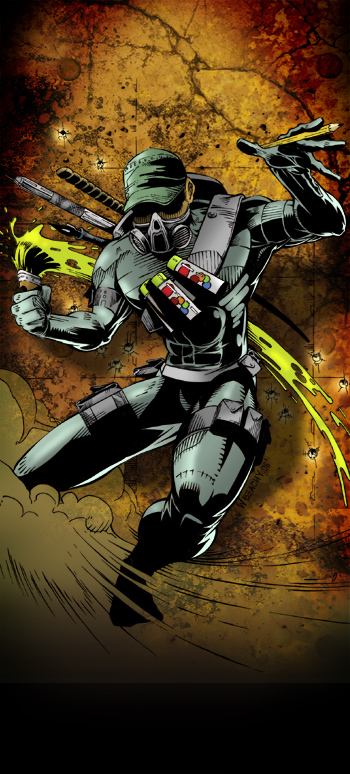
Step x. Import the epitome into your pattern software. I personally use Adobe Illustrator, I think information technology's the best. But y'all can utilize Freehand or Corel Draw. Use the "place" function to import your artwork into your Illustrator file.
Stride xi. Add text and graphics. Add text and vector graphics onto your prototype every bit you would whatever photograph.
Step 12. Export the final design. That's information technology you're done!
I know that this tutorial did not go into all the details one could think of, only I wanted to requite people a general understanding of the process of how we create our illustrated designs. We understand in that location are many aspects to drawing, illustration, and coloring. We could spend all day writing about the ins and outs of it. Keep in listen that this is non the only way to exercise this type of piece of work. It'southward merely a process that works for me. You may notice yourself discovering shortcuts or other methods and nosotros encourage you to experiment. If yous have whatsoever questions, only ask!

Source: https://gomedia.com/tutorials/comic_book_style/
Posted by: wilkinsmusection.blogspot.com
0 Response to "How To Draw Graphic Novel Style"
Post a Comment