

How To Draw Scatchard Plot In Excel
Introduction
In a saturation binding experiment, y'all vary the concentration of radioligand and measure binding. The goal is to determine the Kd (ligand concentration that binds to half the receptor sites at equilibrium) and Bmax (maximum number of binding sites).
The ligand binds not only to receptors sites, but also to nonspecific sites. In that location are three approaches to dealing with nonspecific binding.
• Decrease off the nonspecific, and analyze only the specific binding. Read on for this approach.
• Analyze the total binding only, inferring the amount of nonspecific binding from the shape of the total binding bend. Learn more than.
• Globally clarify the total and nonspecific binding at one time. Learn more.
Step by step
Create an XY data table. Enter radioligand concentration into X, and specific binding into Y. If you have several experimental conditions, identify the commencement into cavalcade A, the second into cavalcade B, etc.
An alternative approach would be to enter total binding into column A, and nonspecific into column B. Then employ the Remove Baseline analysis to subtract column B from column A, creating a new results tabular array with the specific binding.
From the table of specific binding, click Analyze, choose nonlinear regression, choose the panel of Saturation Binding equations, and choose One site specific bounden.
Model
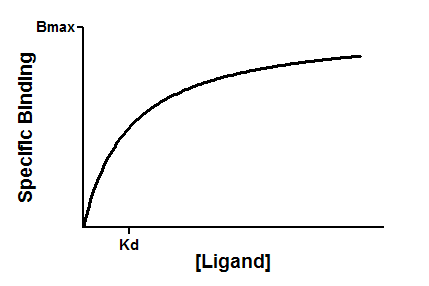
Y = Bmax*X/(Kd + X)
Interpret the parameters
Bmax is the maximum specific binding in the same units as Y. It is the specific binding extrapolated to very high concentrations of radioligand, and so its value is almost always higher than any specific binding measured in your experiment.
Kd is the equilibrium dissociation constant, in the same units as X. It is the radioligand concentration needed to accomplish a half-maximum binding at equilibrium.
Create a Scatchard plot
Before nonlinear regression was available, investigators had to transform curved data into straight lines, so they could analyze with linear regression. Ane way to do this is with a Scatchard plot, which plots specific binding vs. the ratio of specific bounden to the concentration of gratis radioligand.
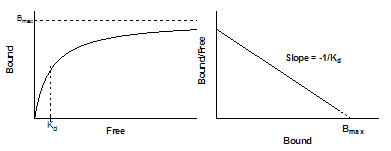
If you lot create a Scatcahrd plot, apply it merely to brandish your data. The homo retina and visual cortex evolved to detect edges (straight lines), not rectangular hyperbolas, and so information technology tin help to brandish information this way. Scatchard plots are often shown every bit insets to the saturation binding curves. They are especially useful when y'all desire to evidence a change in Bmax or Kd.
Don't use the slope and intercept of a linear regression line to determine values for Bmax and Kd. If you practise this, yous won't go the well-nigh authentic values for Bmax and Kd. The trouble is that the transformation distorts the experimental mistake, so the data on the Scatchard plot do not obey the assumptions of linear regression. Use nonlinear regression to obtain the virtually accurate values of Kd and Bmax.
To create a Scatchard plot from your specific binding data, use Prism's Transform analysis, and cull the Scatchard transform from the console of biochemistry and pharmacology transforms.
To create a Scatchard line corresponding to the nonlinear regression fit, follow these steps:
ane. Create a new XY data tabular array, with no subcolumns.
2. Into row i enter X=0, Y=Bmax/Kd (previously adamant by nonlinear regression).Yous demand to do the calculation manually, and enter a number.
three. Into row ii enter 10=Bmax and Y=0. Again enter the number into the 10 column, not the text 'Bmax'.
4. Annotation the name of this data table. Perhaps rename it to something appropriate.
five. Become to the Scatchard graph.
six. Drag the new table from the navigator and drop onto the graph.
7. Double-click on one of the new symbols for that data ready to bring upward the Format Graph dialog.
8. Choose to plot no symbols, but to connect with a line.
Notes
• This is not the all-time way to decide Bmax and Kd. It is improve to globally fit total and nonspecific bounden, without subtracting to compute specific bounden.
• When making a Scatchard plot, you have to choose what units you want to use for the Y-centrality. Some investigators express both free ligand and specific binding in cpm so the ratio bound/free is a unitless fraction. While this is easy to interpret (it is the fraction of radioligand bound to receptors), an culling is to express specific binding in sites/cell or fmol/mg protein, and to limited the free radioligand concentration in nM. While this makes the Y-axis hard to interpret visually, information technology provides correct units for the gradient (which equals -i/Kd).
• This equation is equivalent to the Langmuir isotherm for the absorption of a gas onto a surface.

Source: https://www.graphpad.com/guides/prism/latest/curve-fitting/reg_one_site_specific.htm
Posted by: wilkinsmusection.blogspot.com
0 Response to "How To Draw Scatchard Plot In Excel"
Post a Comment